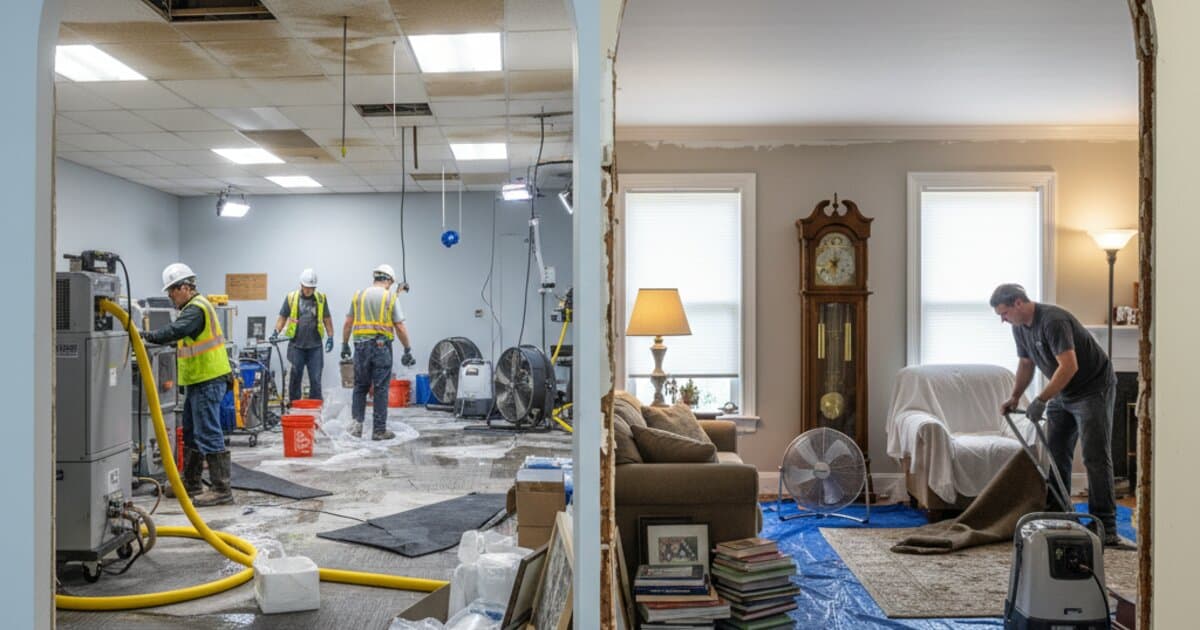
When property damage strikes, the restoration process varies dramatically depending on whether the building is a home or a commercial facility. While the fundamental science of water extraction, drying, and reconstruction remains the same, the scale, complexity, regulations, and business considerations involved in commercial restoration set it apart from residential work. According to the Insurance Information Institute, commercial property damage claims average significantly higher than residential claims, with water damage remaining the most common cause across both sectors.
Key Differences Between Commercial and Residential Restoration
Scale and Equipment
A residential water damage job might involve one to three rooms and a few hundred square feet. A commercial project can span tens of thousands of square feet across multiple floors. The IICRC S500 Standard for Professional Water Damage Restoration applies equally to both, but commercial jobs require substantially more equipment — dozens of air movers, multiple commercial dehumidifiers, and truck-mounted extraction units — to meet the same 3-to-5-day drying standard. People First Restoration maintains a commercial-grade equipment fleet capable of handling large-scale projects without compromising drying timelines.
Timeline Pressures
For homeowners, the urgency is about getting back to normal life. For business owners, every day of downtime represents lost revenue. The NFPA reports that 43% of businesses that experience a major fire or disaster never reopen, and of those that do, 29% close permanently within three years. This makes speed of restoration not just a convenience but a matter of business survival. Commercial restoration teams often work extended hours, including nights and weekends, to minimize business interruption.
Regulatory and Compliance Requirements
Commercial buildings must comply with a range of regulations that do not apply to residential properties:
- ADA compliance — Restored spaces must meet Americans with Disabilities Act accessibility standards
- Fire and building codes — Commercial reconstruction must meet current fire codes, occupancy requirements, and building standards
- OSHA regulations — Restoration work in occupied commercial buildings must comply with workplace safety standards
- Environmental regulations — Larger commercial projects may require environmental impact assessments, particularly when hazardous materials are involved
- Health department requirements — Restaurants, medical facilities, and food processing plants face additional sanitation and inspection requirements
Insurance Complexity
Commercial property insurance differs fundamentally from homeowners coverage. Commercial policies often include business interruption coverage, which compensates for lost income during restoration. However, these claims are significantly more complex to document and negotiate. The Insurance Information Institute notes that commercial property claims require detailed business records, revenue documentation, and expert loss calculations that go well beyond the scope of a typical residential claim.
Commercial-Specific Challenges
Business Interruption
The financial impact of property damage extends far beyond repair costs for businesses. Lost revenue, displaced employees, missed contracts, and damaged customer relationships can dwarf the physical restoration expenses. FEMA estimates that 40% of small businesses never reopen after a disaster, making rapid restoration a critical lifeline. People First Restoration works with commercial clients to develop phased restoration plans that allow partial business operations to continue during the restoration process when possible.
Tenant and Stakeholder Coordination
Commercial properties often involve multiple tenants, property management companies, and ownership groups. A water damage event in a multi-tenant office building or retail center requires coordinating communication, access, and scheduling across all affected parties. Restoration companies must navigate these relationships professionally while maintaining project momentum.
Large-Scale HVAC Systems
Commercial HVAC systems are exponentially more complex than residential units. Ductwork spans entire buildings, air handling units serve multiple zones, and contamination in one area can spread throughout the system. After water damage or fire damage, commercial HVAC systems often require complete inspection, cleaning, and potentially replacement — a process that can take weeks and costs tens of thousands of dollars. The EPA recommends maintaining indoor humidity between 30% and 60% after water intrusion, which requires careful coordination with these large-scale climate control systems.
Specialized Facilities
Restaurants, medical offices, data centers, warehouses, and manufacturing facilities each present unique restoration challenges. A flooded server room requires different expertise than a fire-damaged restaurant kitchen. People First Restoration has experience across facility types and tailors our approach to the specific requirements of each commercial environment.
Residential-Specific Challenges
Personal Belongings and Sentimental Items
While commercial properties contain equipment and inventory with clear replacement values, homes contain irreplaceable items — family photos, heirlooms, children's artwork, and personal documents. Professional restoration companies prioritize content restoration, using specialized techniques to salvage items that homeowners might assume are lost. Our team carefully inventories, cleans, and restores personal belongings whenever possible.
Temporary Housing
When a home is uninhabitable during restoration, families need temporary living arrangements. Most homeowners insurance policies include Additional Living Expense (ALE) coverage that pays for hotels, rental housing, and related costs. The average homeowners insurance claim for water damage is $12,514 according to the Insurance Information Institute, but claims involving displacement and temporary housing can be significantly higher.
Family Disruption
Property damage affects families emotionally as well as financially. Children may need to change schools temporarily, daily routines are disrupted, and the stress of living in temporary housing compounds the anxiety of dealing with property damage. People First Restoration understands these pressures and works to minimize the time families spend displaced from their homes. We offer emergency restoration services with rapid response to begin the restoration process as quickly as possible.
Health Concerns
Residential water damage raises immediate health concerns, particularly for vulnerable family members. The CDC reports that exposure to damp and moldy environments is associated with upper respiratory symptoms, coughing, and wheezing — risks that are amplified for children, elderly family members, and anyone with respiratory conditions. Prompt mold remediation is essential in any residential water damage situation.
Insurance Differences
Homeowners Insurance
Standard homeowners policies cover sudden and accidental water damage, fire damage, and storm damage. Coverage is relatively straightforward, and claims typically involve a single adjuster and a defined scope of work. The IICRC S500 standard provides the framework for scope documentation that most residential insurers accept.
Commercial Property Insurance
Commercial policies are more complex and may include:
- Business interruption coverage — Compensates for lost income during restoration
- Extra expense coverage — Pays for costs to maintain operations during restoration (temporary space, equipment rental)
- Tenant improvements coverage — Covers build-outs and customizations made by tenants
- Equipment breakdown coverage — Covers damage to specialized commercial equipment
Commercial claims often involve forensic accountants, business valuation experts, and multiple rounds of negotiation. Working with a restoration company experienced in commercial claims documentation is essential for a fair settlement.
Why Choose a Company That Handles Both
Choosing a restoration company with experience in both commercial and residential projects provides distinct advantages:
- Comprehensive equipment inventory — Commercial-grade equipment handles large residential jobs efficiently, and residential expertise ensures attention to detail on commercial projects
- Insurance expertise across policy types — Understanding both homeowners and commercial policies means smoother claims navigation regardless of the project
- Flexible workforce — The ability to scale crews up or down based on project size ensures the right team for every job
- Full-service capability — From [water damage repair](/services/water-damage-repair) and [storm damage restoration](/services/storm-damage-repair) to [property reconstruction](/services/property-reconstruction), a full-service company eliminates the need for multiple contractors
People First Restoration serves both homeowners and businesses throughout Central Florida. Whether you are dealing with a flooded office building or a kitchen leak, our team brings the same commitment to quality, speed, and customer service.
The Bottom Line
Commercial and residential restoration share the same science but demand different approaches. Understanding these differences helps property owners set realistic expectations and choose the right restoration partner. For more details specific to commercial properties, explore our commercial property damage guide. People First Restoration offers a free inspection, direct insurance billing, and 24/7 emergency response for both commercial and residential properties across Volusia, Seminole, Orange, and Osceola counties.
Call us at (888) 278-8054 for immediate assistance — we are available around the clock.
Sources
- IICRC S500 Standard for Professional Water Damage Restoration — Industry standards for professional drying timelines, equipment requirements, and scope documentation for both commercial and residential projects.
- National Fire Protection Association (NFPA) — Data on business failure rates after major disasters (43% never reopen) and fire damage statistics for commercial properties.
- Insurance Information Institute (III) — Statistics on commercial vs. residential property claims, average claim costs, and insurance coverage types.
- FEMA (Federal Emergency Management Agency) — Small business disaster recovery data, including the 40% permanent closure rate after major disasters.
- U.S. Environmental Protection Agency (EPA) — Indoor air quality and humidity control guidelines for commercial and residential buildings after water damage.